

Green Campus
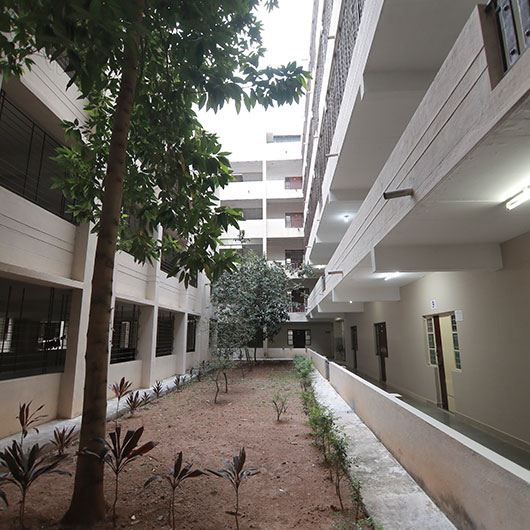
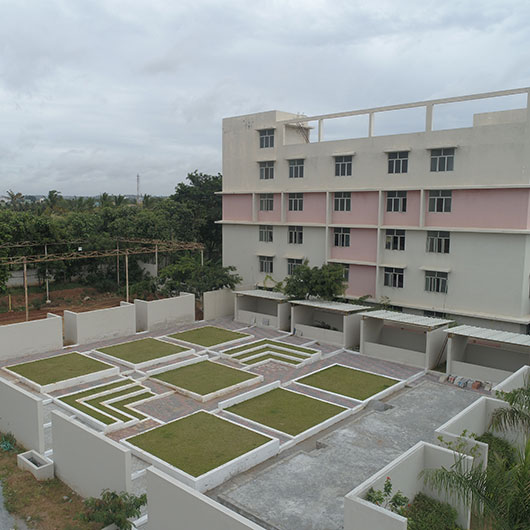
Rainwater is harvested from the roofs and open ground of the 50-acre campus and returned to the ground. Waste is separated and reused, and energy is saved wherever possible.
- Campus
- 50 acres
- Average rain a year
- 867 mm
- Roof water a year
- 18,457 kL
Water
Rain, returned to the ground
The harvesting system was installed to make the college self-sufficient in water — for daily use, and for its lawns and gardens — and it recharges the groundwater beneath the campus.
How the rain is harvested
-
Collected
Runoff from open ground is caught by a trench at the main gate; rain from the roofs is led through the storm-water drains.
-
Filtered
The water passes a filter tank 2 m across and 2 m deep and a collection chamber 1 m across and 1 m deep; layers of brick inside the recharge wells filter it again.
-
Recharged
Recharge wells 3 m across and 5 m deep, an abandoned open well and deep bore wells return the water to the aquifer.
On an average year’s 867 mm of rain
- 18,457 kL of water from the roofs
- 2,80,260 kL from the open ground
Harvesting eases the demand for treated water and the cost of treating it, lets the groundwater recover where it has been over-drawn, and teaches every student who sees it at work.

Waste
Separated, reused, disposed of safely
Waste is prevented where it can be and separated where it is made, so that as much as possible is reused and the rest is disposed of safely.
- Solid waste Separated where it is made, into bins for dry and for wet waste, and kept apart to the corporation’s collection vans.
- Liquid waste A drainage system leads to closed collection tanks, cleaned regularly so water never stands; the sewage is treated by dilution, so natural oxygen breaks it down.
- Electronic waste Kept for teaching in the laboratories, repaired in the maintenance room, and reused — tube-light chokes in the campus’s automatic street lights; what cannot be reused is sold as scrap by contract.
What the campus separates
- Food
- Garden
- Paper
- Polythene
- Biomedical
- Electronic
- Metal
Energy
Less power, more green
- Daylight first, and lights and equipment switched off when not in use
- Energy-efficient equipment, with its power-saving settings on
- LED and CFL lamps in place of tube lights
- Air conditioning kept to a minimum, and water used carefully
- The campus’s green cover maintained, with indigenous trees planned
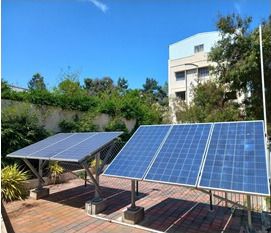
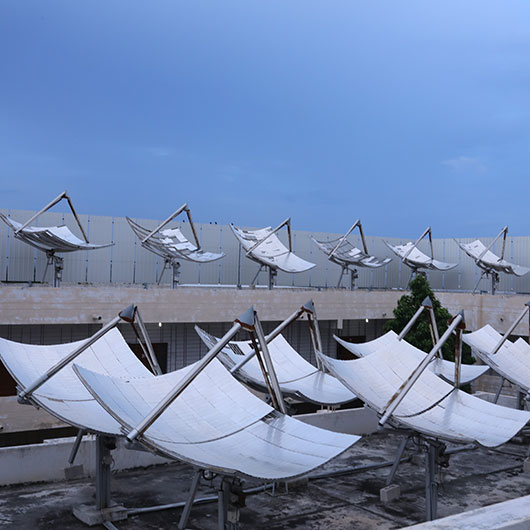
Solar on the rooftops. Solar concentrator dishes on the roof and photovoltaic arrays in the grounds are the Renewable Energy centre of excellence, where students train.
Centres of Excellence